
How it works
Five practice visits to Tom's flat, then a record for the manager.
Five visits to Tom's flat
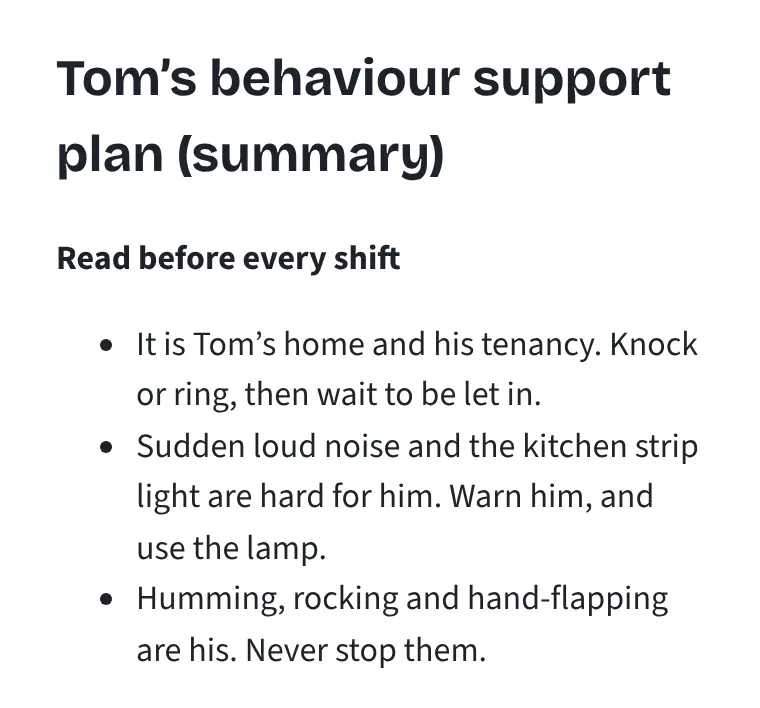
- First visit. Knock, say who you are, wait, and follow his house rules.
- Getting to know Tom. Ask him, not the person who answers for him.
- A hard afternoon. Drilling next door. Follow his behaviour support plan, then step back and call for help.
- A change of plan. The seaside trip is off. He says “OK”, then stands at the door, coat half on.
- Final check-out. A whole shift, and no feedback until the report.
What a new starter practises
- following the behaviour support plan through rising distress, choosing the least restrictive option first;
- using the person's communication plan first: Makaton signs, picture exchange, a visual timetable, fewer words, time to answer;
- checking the room for sensory triggers before distress starts;
- writing records in observable words, with words like
kicked off
flagged; - noticing and recording objection, under the test for deprivation of liberty the Supreme Court set on 2 June 2026;56
- speaking up when a colleague belittles the person or locks the kitchen for everyone.
There is no hands-on restraint anywhere in it. When distress rises, the right answer ends with stepping back and calling for help.
The record you get
What they did in each visit, mapped to the Care Certificate standards7 and the positive behaviour support first step
competences for direct contact workers.8 It ends with what to observe next on shift.
| In the practice flat | Maps to |
|---|---|
| Knocked and waited to be let in. Asked how he likes to be addressed. | Care Certificate: privacy and dignity |
| Used his visual timetable when the trip was cancelled. | Care Certificate: communication. PBS first step: communication |
| Missed the early signs of distress the first time. | PBS first step: following the behaviour support plan |
Incident record said he kicked off. Rewrote it in observable words. | Care Certificate: handling information |
Observe next on shift: whether they notice early signs and check the room for triggers.
Why it matters
A new support worker meets each person on shadow shifts, with their support plan and behaviour support plan to read. Skills for Care says direct supervision should continue until they're assessed as safe to work independently
.1
CQC sets out the risk factors and warning signs that a closed culture may be forming. Several sit in exactly that gap:2
lack of suitable induction, training, monitoring and supervision
A high use of poorly inducted agency staff or locums who do not know people's needs
Poor or absent communication plans ... not being followed
NICE asks that staff giving direct support to people with a learning disability whose behaviour challenges have the direct contact
level competencies of the positive behaviour support competence framework.3
And the first year is when people leave. In 2025/26, turnover for care workers and support workers, local authority and independent sectors combined, was 26.9%. For care workers less than a year into their role, it was 33.7%.4
What it isn't
- It doesn't replace watching them work. The Care Certificate needs observation in real work, by an assessor, and your sign-off. We cover the knowledge and tell you what to observe; the observation stays with you.9
- It isn't Oliver McGowan training. Your staff still need it.10
- It isn't restraint or physical intervention training. Keep the restraint reduction course you use now.11
- It doesn't assess medicines competence. The observed check stays with your competent assessor.12
- It isn't a full training library. Fire safety, food hygiene and the rest stay with whatever you use now.
- It holds nothing about the people you support. We hold staff names, emails and training records only.
- It has no results to show you yet. It is new in England.
- No practitioner has reviewed it yet, and no learner uses it until they have.
Lessons work on a phone. The practice visits are 3D, so they need a laptop or desktop.
Book a 20-minute call